|
|
|
|
|
|
|
|
|
|
"It's a big idea: a new world order , where diverse nations are drawn together in common cause . . . only the United States has both the moral standing and the means to back it up." George Bush, State of the Union address, Los Angeles Times, Feb. 18, 1991.
"Under the courageous leadership of Pope John Paul II, the Vatican State has assumed its rightful place in the world as an International voice. It is only right that this country show its respect for the Vatican by diplomatically recognizing it as a world state." Dan Quayle, Appeal to the US Senate, September 22, 1983.
"(John Paul II) insists that men have no reliable hope of creating a viable geopolitical system, unless it is on the basis of Roman Catholic Christianity." M. Martin, Keys of This Blood, page 492.
"United Nations--Leaders of the Security Council nations were in New York today for their first summit, ready to place the United Nations at the center of a new world order and forge a common policy on peace making and arms control. . . .
"The gathering of leaders of the 15 Security Council nations marks the first time since the founding of the world organization in 1945 that the council, the most powerful U.N. body, has convened at the highest level." Birmingham News, Jan. 31, 1992.
"Willing or not, ready or not, we are all involved in an all-out, no-holds-barred, three-way competition. Most of us are not competitors, however. We are the stakes. For the competition is about who will establish the first one world system of government that has ever existed in the society of nations. . . . The competition is all-out because, now that it has started, there is no way it can be reversed or called off." (Malachi Martin in Keys of This Blood, 15)
"Those of us who are under seventy will see at least the basic structure of the new-world government installed. Those of us under forty will surely live under its legislative, executive, and judicial authority and control. Indeed, the three rivals themselves--and many more besides as time goes on--speak about this new world order not as something around a distant corner of time, but something that is imminent." M. Martin, Keys of This Blood, 15-16.
"Dream of Order. Like many revolutionary ideas, United Europe is not a new notion but an old one revived. The dream of order and unity once embodied in the Rome of the Caesars lived on through the Middle Ages (this period is correctly termed the Dark Ages) not only in the Roman Catholic Church but in the Holy Roman Empire." Time, October 6, 1961.
"What has been forged under the Treaty of Rome in the Common Market is a tightly knit, tightly centralized, tightly directed, tightly controlled new bureaucracy, which is obviously attempting to restore the economic structure of the Holy Roman Empire to Europe." Christian Science Monitor, 1962.
The earth has in the past experienced varying periods of political and social rest during such world empires as the Babylonian, Medo-Persian, Greek and Roman. History has well documented that at the fall of the Roman empire, Europe fragmented into ten separate nations. Over the many centuries, thousands and even millions of persons have perished as different strong-men have attempted without success to put the broken fragments back together again.
World War I was fought with the purported purpose "to put an end to war." The futility of that claim was clearly made evident by the conflagration of World War II. This truly global war came to an end only with the discovery and use of the mind-boggling power of nuclear fission. With the dawning of the atomic era mankind developed weapons of destruction so powerful and so fearful that we have been afraid that any conflict might lead to a nuclear holocaust with the strong probability of destruction of life on this planet.
Peace as the result of fear of mutual destruction has also proved to be less than ideal. Even with the threat of nuclear annihilation the earth has witnessed a multitude of minor armed conflicts and several major wars, such as those in Korea, Vietnam and Afghanistan. Both major powers--Russia and the United States--have pulled out in frustration from wars they could not win with conventional weapons alone but in which they were afraid to unleash the nuclear genie.
Into this frustrating struggle to bring some form of unity and hope to this earth strode a personage and power offering a solution to the felt needs of mankind for peace and stability. In October of 1978, an obscure Polish archbishop, Karol Wojtyla, was elected as both religious head of the Catholic Church and civil head of the Vatican City. This present pope is apparently utilizing his dual role of leadership in an effort to implement his conviction that he is the pope who will return to the throne of the world, the throne the popes were forced to vacate in 1798 at the end of the Dark Ages. Many consider him to be the first modern-day pope possessing the potential of accomplishing such a goal.
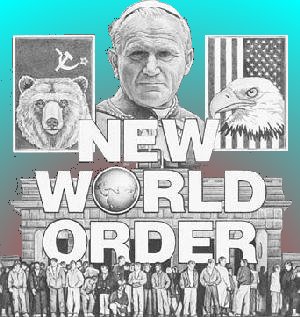
The subtitle to the recently published book The Keys of This Blood (paperback edition) announced a series of events destined to change the world forever. It pointed out the main players in these events and their ultimate goal. The book's subtitle reads thus: "Pope John Paul II versus Russia and the West for control of the New World Order."
The author, Malachi Martin, a Jesuit and Vatican insider, takes a pro-papal view of this battle for control of the world. The book makes certain prophecies about the future of the world, and defines much of the Vatican's strategy to take control of it.
One of the prophecies delineates the pope's strategy to eliminate the USSR. The fulfillment of that prophecy is now well-documented history. The presses of the world have correctly identified the pope's active role in the disintegration of Communism as symbolized by the downfall of the Berlin Wall November 9, 1989.
Now that the former Soviet Union is just a part of history, the players who remain in this battle to influence and to even control the future of mankind are the United States of America, the United Nations and Pope John Paul II. It is yet to be seen whether Communist China will develop or manifest a geopolitical agenda.
Just because one Jesuit author predicts that the New World Order is imminent is not enough to warrant undue alarm. The alarming factor about the issues raised in the book The Keys of This Blood is that they so closely parallel the prophecies written in the Bible over 2000 years ago.
To what lengths will the pope, the United States and/or the United Nations feel compelled to go to bring calm to the seemingly endless conflicts in the world today? What paths will be taken in attempts to bring peace amid the world's present social, political and religious unrest? Will a new world order or government be established in our day in an attempt to regain the relative stability of bygone world empires? We are not left to mere guesswork regarding these vital questions. History and prophecy combine to provide some most startling and sobering insights into the earth-shaking events which lie just before us and the whole world.